09 April 2021

The 20 Best Roller Coaster Names in the World

In honor of the reopening of Coney Island after its year of hiatus, we give you the definitive list of the twenty best roller coaster names in the world.


20. Train Glide On Air (Bao Son Paradise Park, Hanoi, Vietnam)

This is the name that inspired this project. Who would not want to ride Train Glide on Air? It sounds like the most amazing experience to be had, or the most amazing to be had at an amusement park at any rate. Certainly better than Car Slide On Rail.

If we are being truthful, the English version of this ride’s name is probably just a bad translation; something more in the spirit of the original would probably be “Train in the Sky” or “Flying Train” or another appellation far more prosaic. Nevertheless, “Train Glide On Air” is what the website says; “Train Glide On Air” shall it be called.


19. Jet Coaster Super Dolphin (Uminonakamichi Seaside Park, Fukuoka, Japan)

“Jet Coaster” is apparently just the generic Japanese name for “roller coaster”; many Japanese amusement parks have a ride called “Jet Coaster” or some variation thereof. That part is not the point here.

As for the rest: for a seaside park, dolphin would be reasonable enough, if, as we would argue, a little unintimidating. But Super Dolphin? That should really be a Pixar movie. Admit it: you have never in your life considered the possibility of a super dolphin, and now the idea thrills you. Imagine the powers Super Dolphin might have. It could fly! Like … a jet!

Sadly, like many of the rides on this list, Jet Coaster Super Dolphin appears no longer to exist. You cannot experience the Super Dolphin’s roller coaster (jet coaster) simulacrum. Apparently a name alone, no matter how great, is not enough to preserve a ride forever.

While we are here, please say Uminonakamichi three times fast.


18. Tyrolean Tubtwist (Joyland Childrens Fun Park, Great Yarmouth, England)

This is, we confess, not that great a name. The ride consists of tubs that twist as they run along a track through faux Tyrolean scenery. Nevertheless, we place it here in order to share this spectacular video of a man having fun in spite of himself.*

*Let’s be honest, that could be us.


17. Abandon Mine (Uncle Bernie's Theme Park, Fort Lauderdale, Florida)

Who doesn’t love a roller coaster name with a grammatical error that leaves you pondering other potential meanings. Abandon your what, exactly? Abandon your children? Not if we’re leaving them in the care of Uncle Bernie, who owns the sort of theme park that can’t even be bothered to get their rides’ names correct. Someone in the sign shop made that sign, saw it was wrong, and said, “Eh - close enough.” Imagine the kind of message that sends to the maintenance crew. Or maybe Bernie runs the whole place, locking your kids into the carts, throwing the lever to start the ride, heading over to the concession stand to serve a couple burgers while your kids circle the track endlessly, cigarette dangling from his lower lip, unshaven, impervious to the howls coming from over there, what was it I was doing before I came over here to the grill? “Abandon Hope” seems a bit more accurate.


(Bonus Entry) Wiking Coaster (Rabkoland, Rabka, Poland)

There’s not really anything special about this name. However, we call it out here for the helpful translation on the page, “‘Wiking Coaster’ is Polish for ‘Viking Coaster’.” And, because it’s really fun to say “Wiking Coaster.”

You should also follow the link for the totally adorable picture of a tot riding Wiking Coaster.


16. Wolverine Wildcat (Michigan’s Adventure, Muskegon, Michigan)

We get what they were going for here. Wildcat is a pretty common roller coaster name, verging on the pedestrian. The Roller Coaster Database lists 60 rides called “Wildcat,” not including a number more called “Wild Cat” or some other variation. It’s practically generic, like “Jet Coaster” in Japan. So, you know, Michigan’s Adventure, wolverines are the state mammal of Michigan or something, also their football teams; presto: the Wolverine Wildcat. If the park were Japan’s Adventure and the ride were the Jet Coaster Super Wolverine, we wouldn’t be having this discussion.*

*Clearly we would.

But: “practically generic” is not quite generic, in the way that having practically earned your driver’s license cuts no ice with the cops. And so we instead have this modern, theme park version of a gryphon, with the head of a wolverine and the body of a mountain lion, or perhaps vice versa, or perhaps fused at the genetic level, like Jeff Goldblum and a fly. Terrifying! Also: nonsensical! Also: no one really knows what a wolverine looks like, so we’re picturing Hugh Jackman’s head on the body of a mountain lion, and now we’re not going to be able to sleep.

Seriously, why not just go with “Wolverine”? Do you want to know how many roller coaster names the Roller Coaster Database lists starting with “Wolverine”? One: Wolverine Wildcat. They could have been unique; instead they ended up with a mythical creature that is half-generic, half-unimaginable.

On the other hand, “Wolverine” would not have made this list.


15. Mighty Mini Mega (Adventure Island, Southend on Sea, England)

“Mighty Mini”: that is a name we can understand. The little kids will see the word “mighty,” assuming they can read, and feel super grown up about the ride they are about to embark upon.

“Mini Mega”: a little contradictory, but again, we can sort of imagine a park with a ride called the Mega Something - Mega Dolphin, maybe - and this is the junior version of it, again for the little kids who aren’t quite ready for a full blown jet coaster.

“Mighty Mega”: that is definitely a roller coaster name we could get behind.

“Mighty Mini Mega”: make up your damn mind already.

Note: Adventure Island lacks any other roller coaster with the name “Mega” involved. The idea that this is “Mini Mega” makes no marketing sense.


14. These United States (Sun Fun Park, North Myrtle Beach, South Carolina)

We are trying to imagine what happened here:

Amusement Park Impresario (to project manager): “And I want a stage with a show called “These United States,” it’s gonna be historical, it’ll have the Rockettes in little red, white and blue sequined costumes, there’ll be Sousa marches and we’ll have Mount Rushmore and cannons and a salute to American cheese and the whole thing will end with fireworks.”

Project Manager (to construction crew): “And over here we’re gonna have an attraction called ‘These United States’” (hands over design memo; goes on vacation for 18 months).

Construction Crew: (misplaces design memo; builds roller coaster)


Project Manager (to impresario):
“Small conceptual change …”


13. Diving Coaster: Vanish (Yokohama Cosmoworld, Yokohama, Japan)

Like many of the entries on this list, this shows what happens when you are not content with the ordinary, and seek the extraordinary.  “Diving Coaster”: ehhh.  “Diving Coaster: Vanish”: now that’s a name. We like to imagine “Vanish” being said in a stage whisper, like a third-rate magician telling you he’s going to make his assistant disappear when you can plainly see she’s just dropping into the box’s false bottom. Which, by the way, is pretty much what this roller coaster does; it goes into a tunnel.  Marketing.


12. Orphan Rocker (Scenic World, Katoomba, Australia)

What the what? There is a video about this ride that claims it is the most dangerous in the world, and we have to say, that seems plausible enough. It is not clear whether it ever operated, perhaps because people did not flock to a ride whose name somehow implies that it will do horrible things to your anatomy that will cause you to lose your parents.


11. Broken Rail Roller Coaster (Great Xingdong Tourist World, Anshun, China)

We are going to leave behind the fictionalized plural of this commentary to note that even Kathy Hammett and I are not going to ride the Broken Rail Roller Coaster.


10. Whirly Roller Coaster (Floraland Continent Park, Chengdu, China)

Truth in advertising; it is indeed whirly.


9. Fast Coaster (Kok Tobe, Almaty, Kazakhstan)

Truth in advertising cannot be confirmed from still pictures. The database lists four roller coaster names beginning with “Fast”; none beginning with “Slow” or “Medium.”


8. New Wilder Wild Mouse (Lagoon, Farmington, Utah)

An even more impressive example of advertising built right into the name. The redundancy is especially pleasing.

This ride operated from 1973 to 1989, replacing the (apparently ordinary) Wild Mouse. Do you suppose by, say, 1980 or so, management was saying, “We really need to change that name; we can no longer fool people into thinking this ride is newer or wilder than it was last year”? In any case, they learned their lesson, and in 1998 they opened a new Wild Mouse entirely lacking in comparative claims.


7. Whistle Punk Chaser (Dollywood, Pigeon Forge, Tennessee)

Well. It turns out – we have spared no effort in compiling this list – a whistle punk is an actual thing, and it has nothing to do with the Keystone Kop chasing a miscreant youth down a cobblestone street that we had pictured. Webster says a whistle punk is “a lumberjack who operates the signal wire running to a donkey engine whistle” which … we know what each of those words mean, but not all of them together, and certainly not in the context of Dollywood. It is also not clear who is chasing the whistle punk and why. It seems like “Log Ride” might have been clearer – and yet, as in so many pursuits, in artistry does greatness lie.


6. Speedy Bob (Bobbejaanland, Antwerp, Belgium)
   
Oki Doki (Bobbejaanland, Antwerp, Belgium)

A twofer for Bobbejaanland – and rabbit-hole time. But first: Oki Doki means exactly what you think it means, and if Kathy Hammett and we – I – were at Bobbejaanland I am fairly certain we would be repeating the phrase Oki Doki until one of us grew exceedingly tired of it, which would not stop us – me – from carrying on with it far too long. As for Speedy Bob, we suppose it might be meant to suggest bobsleds. However, there is a second ride at Bobbejaanland called the “Bob Express,” which you would think would cause endless confusion for guests, and perhaps does, but which more pertinently features a train engine at in front of the coaster cars, suggesting the name(s?) have nothing to do with bobsleds, but rather our preferred scenario where the park owners named the ride “Bob” in homage to Bobbejaan.


Which brings us to that rabbit hole. Bobbejaanland is kind of the Dollywood of Belgium. It’s named for its founder Bobbejaan Schoeppen, who was an enormously popular Flemish singer beginning in the 1940s and on into the 1970s. His Wikipedia page, which is well worth a read, says he was “a versatile entertainer, entrepreneur, singer-songwriter, guitarist, comedian, actor, and professional whistler” – professional whistler!  In 1943, at the age of 18, he appeared in a cabaret and sang a South African song with the lyrics “Mommy, I want a husband. No mommy no, I don't want a German ‘cause I don't like pig meat.” It did not endear him to the occupying Nazis. They closed the concert hall and hauled Schoeppen off to a work camp for three months.

After the war, he and a friend took their act on the road. It was then that he took the name Bobbejaan, which is “baboon” in Afrikaans, and became increasingly popular, etc., you can read the Wikipedia page, it really is worth your time. Eventually, he tired of club owners keeping most of the take, and bought a circus tent, and would travel around throwing up his tent and putting on a show like we all dream of doing, Zorro’s horse is involved, he became a film actor – really, read the Wikipedia page. Finally he tired of the road, bought 30 hectares of swamp, put up the tent permanently and started letting his fans come to him instead of the other way around.
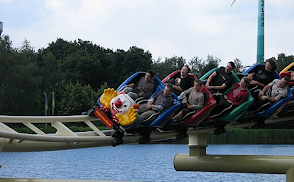
They called the place “Bobbejaanland,” and over time, as Wikipedia puts it in an exceedingly lovely and heartbreaking sentence, “The amusement park finally dominated the cabaret, and the entrepreneur the artist.” Schoeppen and his family ran the park until 2004, when he sold it, and he and his wife continued living there until his death in 2010.

And if you persist in believing, after all that, that “Speedy Bob” refers to bobsleds, I don’t know what to do with you.


5. Termite Coaster (Wonderla Amusement Park Bangalore, Bangalore, India)

We leave to you to decide which is more salient: the name “Termite Coaster,” or the fact that there are, not one, but four roller coasters in India themed to termites.


4. Traumatizer (Southport Pleasureland, Merseyside, England)

“Thriller”? Sure. “Screamer”? You betcha. “Timber Terror”? Outta my way.

“Traumatizer”? We’re gonna sit this one out.


3. Hundeprutten (Bon-Bon Land, Holme-Olstrup, Denmark)

Punch that one into Google Translate. We’ll wait.


2. Stress Express (Fantawild Adventure, Zhengzhou, China)

Your Coworkers, The Ride.


1. Super Speed Cool-Cool Bear (Beijing Amusement Park, Beijing, China)

Our winner, and as the Australian horse racing announcers say, “daylight second.”

08 January 2021

me and alex

I dreamed I was on Jeopardy! last night. It was a dream about being unprepared. Throughout the entire dream I was asking people for things, for paper, for pens, I was wearing shorts, I forgot about my retainer, I didn't have a mask (neither did anyone else, and I realized it was a television set so people didn't wear masks). The other contestant was a young woman who looked quite a bit like the main character in The Queen's Gambit and similarly had her shit together. At one point, as I was looking for something, she looked up from her phone and said "The Falconworks website is confusing" and I realized she had been googling me. I hadn't thought to google her. It was that kind of dream.

Alex Trebek was there. I talked to him twice. He had a man-bun in one of our conversations, which seems pretty unlikely; it was that sort of dream, too. 

I suppose I might have had this dream because Alex's last appearance as the host of Jeopardy!, taped before his recent death, airs this week. I hadn't been consciously aware of that, though. I woke up and wrote my dream down. As I was writing I thought, again as I have recently, about the ways Alex Trebek and I crossed paths throughout my life. Not quite crossed; I never actually met the man. But he would enter my consciousness in some salient way every so often. It might be a little strange. But, you know, I can be a little strange. My mom once said I was the only kid she ever met who didn't like ice cream. (I did, in fact, like ice cream, especially French vanilla, but I didn't like the way it made me thirsty, and there was never an option to get a drink afterward. I am making up for it at probably the worst time.)

What I also liked as a kid was game shows. They fascinated me. They still do, I suppose, although I don't watch them the way I did as a kid, which is to say at every opportunity. The Joker's Wild, The Price is Right, Press Your Luck (man, do I love the Press Your Luck story from This American Life). Password. Concentration was pretty boring. Wheel of Fortune was also pretty boring; Merv Griffin supposedly once said that the secret to Wheel of Fortune was that 90 percent of the audience could guess the puzzle before the contestants do, and I think I saw through that at the age of nine. Jeopardy! was the best of them. Art Fleming, the original host, had an incredible panache as he would run the game through its paces: "The answer is...!" he would declare after a contestant chose a clue. It disappeared after a while; not enough glitz for the seventies, or maybe too brainy for the midday crowd. Ninety percent of the audience couldn't guess the clues. 

Then they announced they were bringing it back, with Alex Trebek as the host. I was excited and disappointed. Alex had been the host of a couple other shows on the "meh" list. He was a retread, generic game show host #4. And he was easily mocked in the early going. My sophomore year at Kenyon we would gather in the dorm lounge after dinner each evening for half an hour of Jeopardy! and between shouting out answers - or technically questions - we would ridicule his French accent, his occasional supercilious tone when a contestant guessed wildly wrong, his general air of being the smartest guy in the room when we all knew he was a second-rate talent getting his last chance. He was an easy target for college students. We in the lounge among us actually knew French and African geography and had read the whole of Shakespeare's sonnets. We were twenty and we knew everything. We used to speculate on his conversations with contestants after the show, as the credits were rolling. "And then I was on High Rollers," we imagined he would remark, the three poor souls trapped behind their  podiums nodding and smiling lest they not receive a lifetime supply of Creamettes. 

I left college; Alex left my life for a while. Then he came back to me. Against my instructions, my parents bought me a television, and living alone in Southern California, I almost certainly would turn to "Jeopardy!" to fill half an hour of my evenings. I don't really remember any details of that. What I do remember was an instance of the Los Angeles Times' "Hot Properties" column, which profiled the houses being purchased by celebrities. Alex and his wife had bought a house in the Hollywood Hills, as one does if one is a prominent game show star (or "host," as he used to insist). He talked about how appealing the house was for "young couples" like them. He would have been about 50 at that point. I was 25 and applying the word "young" to himself seemed ridiculous to me. Then again, I'm 55 now and it still does.

More significantly, my friend and former high-school English teacher Lance qualified as a contestant, and came over to Los Angeles for a taping. We met outside the Sunset Las Palmas Studios; Lance disappeared backstage and his wife Judy and I went to the back row where friends and family were placed, so that we couldn't relay answers with winks or flashcards or semaphore flags or whatever they imagined we might use. I think Alex came out to warm up the audience, maybe take a few questions. I could still see through the veneer, even as the rest of the audience were totally charmed by his combination of elegance - he really did know how to wear a suit - and approachability. He had sincere charm, and he had charming sincerity. Then he went backstage to do his job.

They taped the shows "as if live"; that is, if the show lasted 28 minutes beginning to end, they took 28 minutes to tape it, pausing the action for the exact length of the commercial breaks and striking up the theme music as the breaks ended. Or nearly. They could pause and re-tape a moment if needed; not contestants answering questions of course, but an intro that got bungled or a clue that Alex had mispronounced. They did that once or twice. More memorably, there was a moment when there was a doubt as to whether a contestant had actually given an acceptable response to a clue, but not the answer the hosts were looking for. After the round, they paused to reconsider it. The judges deliberated a while. "The judges" - such a grandiose term. They were probably two producers and a lawyer, the producers trying to keep the audience happy and the lawyer making sure they wouldn't get sued. They deliberated more. Finally Alex expressed exasperation. "The audience expects us to get this right!" Applause. He might have been exasperated; it might have been schtick. The audience wasn't fussed about which.

Lance racked up a pile of virtual money but took second, which meant, as far as I know, it didn't become real money, just the home version of the game and possibly some Rice-a-Roni. Sic transit gloria mundi and all that. 

We had lunch, parted, I watched the episode when it aired. I got older, I got busier, I got married. I would still watch Jeopardy! when I thought of it, when I was home from work in time. 

Then I read about upcoming online tests to be a contestant. I had actually tried this once before, in person, back at the Sunset Las Palmas studios, when I was still in Southern California. "If Lance can do it, I can," I thought, not realizing - setting aside the probability of Lance's greater intellect - that there's a significant advantage to age in Jeopardy! You live through things other people learned in history class, if their American history class even managed to get past WW2. You pick up stuff. You see a lot more movies and hear a lot more songs. And the audience probably skews older, so the pop culture references do, too. We had taken a written test and were waiting outside, comparing experiences. I mentioned a question where I'd drawn a blank and guessed wildly. My counterpart was almost angry at my youthful ignorance. "Valentino was an actor!" he shouted at me. I took some pleasure in seeing him dispatched from further consideration the same as I was.

The online test was if anything more nerve wracking. Filling out 50 or 100 answers on paper, you at least had the chance to skip and maybe come back to one that was just escaping your grasp. Online, the time counted down, the question vanished, and along with it the chance to answer. I finished demoralized. It turned out I shouldn't have been. Some weeks later I got an email inviting me to the Waldorf-Astoria for an in-person tryout.

I won't describe that experience blow-by-blow. We were sworn to secrecy about the whole process. I actually don't care about that, at this point, but in fact I wrote a whole piece about it at the time and I'll try to dig that up if anyone is interested. Suffice it to say it was one of the most fun afternoons I can remember. And of course it gave me another chance to cross paths with Alex. Not in person; he was by that point a legitimately big enough star that he didn't have to cross the country doing contestant searches. But they had a big screen at the front of the room, and as we prepared to take our second exams, to confirm the results of the online one, Alex's face appeared, welcoming us in his friendly but serious manner, like that teacher who was both your favorite and your most demanding, Mr. Chips or something. And then he read the questions (answers) to us and we madly scribbled down answers (questions, although I don't think we had to phrase our responses in question form). 

The age advantage proved true; I nailed the test. At least I felt that way, they never told us the results. Then we had to play a simulated game in front of everyone, including a mock interview. No Alex for this part of the audition, just a producer and a casting person, peppering us with questions. Somewhere along the way, I didn't nail that bit. They sent us on our way, telling us we might hear from them, we might not. They wouldn't tell us if we'd made the cut or were on the waitlist, how many of us would be called or how long we might wait. I waited. The call never came. I was disappointed, but honestly spending three hours seeing how the sausage was made was a pretty good consolation prize.

Not because of this, or at least not that I can remember, I watched Jeopardy! a bit less over time. Netflix came along and we dropped cable, and only deployed the rabbit ears for special occasions like the World Series. I went back to regular work that kept me from getting home 'til late in the evening. I kinda forgot about Alex for the most part. Once I was at my folks' house back in Ohio and after the evening news the familar refrain, "This. Is. Jeopardy!" rang out. I felt a momentary delight. 

"Ugh!" said my dad. My mom grabbed the remote. "You don't want to watch Jeopardy!?" I said, incredulous. 

(Pause for a moment here to observe the reverse-interrobang in the previous sentence.)

"No!" was the response. That was that. I went into a brief Alex withdrawal.

And then, again, I kinda forgot about him, until the news came of his cancer, then remission, then a relapse. It was, it is, pretty heartbreaking. Not for myself, for the most part. I did - I do - feel a little pang of loss. After a distant miss and then a nearer miss, I still imagined I would be standing at the podium some day, chatting with him about coaching little league baseball and his days on The Wizard of Odds. 

More, perhaps, it's the feeling of getting older. Life goes on and we discover we can't plop on the lounge sofa and watch Jeopardy! four or five nights a week. Sic transit, too, those glorious Monday evenings, when time was endless. 

And still more, the end of, in its minor way, an era. The tributes written before and after Alex Trebek's death have been lovely and heartfelt and spoke of the connection he forged, over the airwaves, with the audience, and audience who would carve out a part of their California vacation to see him in person, applaud in the way they couldn't from home. The connection was bogus, show biz, of course. Or maybe it wasn't, who am I to say?

I read some of those tributes and they all referred to the way he would practice French words, the way he would handle the contestants, especially when they would blow an easy clue, his insistence on being the "host," not the "star," because a star is distant whereas your host is your friend. They talked about his charming sincerity. 

I hope that's all true. I honestly think it is, or at least I choose to. And yet, in reading the descriptions of how Alex went about his work and his career, I saw a different quality. 

Alex Trebek was a professional. He thought seriously about his role, about how to do it well, and he worked at it. It's not easy to convey a sense that you're the most knowledgeable man in the room when everyone knows you've got both the answers and the questions. It's not easy to be Mr. Chips. Hell, it's not easy to look that good in a suit (although having a wardrobe department and Armani as a sponsor probably helps.)

It wasn't about art, and I don't think he had any delusions about that. You can find interviews where he talks about wanting the show to do well, "because if we do well, then I do well." 

I don't know what he was like to work with. He might have been a diva, although that's certainly not what you read. I would believe he didn't suffer fools. He almost certainly didn't suffer amateurs. Well: I've spent enough time in a little corner of show business to know what a gift it is to be around a stage with someone who walks in the door ready to work, capable and prepared and expecting you to be the same. 

I don't have a finishing note here. I won't be watching Alex's final show tonight: no cable or rabbit ears here. I might be a little disappointed by that, but in truth making a special point of seeing it, when I haven't been watching in recent years, seems like it would be a little silly. It was my good fortune that my path neared his a few times. 

04 November 2018

marathon day 2018

Cowbell: check. Bright clothes: check. Sign: check. Marathon prep for Sean M Enright complete.

Image may contain: 1 person, outdoor

Sorry you didn't see the sign, Sean, but some other guy named Sean stopped and took a picture of it!
Image may contain: 1 person, shoes, basketball court, tree, sky and outdoor

Image may contain: one or more people, shoes, basketball court, crowd and outdoor


27 October 2018

jfrej

A week from now I will be a year older. It doesn't seem like it should work that way but I am assured it does. In any case, facebook which knows everything about me thinks I should set up a fundraiser and at first I was like "eh" but they say they'll do it free (in exchange for, you know, your info and your eyeballs but that's on you I guess). So:

I had the very good fortune recently to meet a poet and teacher named Simon Lichman. We were trapped in tiny plane seats next to each other and over the course of two hours talked about pretty much everything you can imagine, most of it about art and justice and religion; whether it's possible to be a secular Christian; his work with Palestinian and Israeli youth; his trip to Lithuania and Poland. More than anything else, what stuck with me was the idea of the "stranger in our midst," an idea that occurs again and again throughout the Old and New Testaments. In Exodus, for example: "There shall be one law for the citizen and for the stranger who dwells among you."

So with that in mind I am asking you to pledge a few bucks to Jews for Racial and Economic Justice. They are on the front lines of the social justice movement, fighting for the rights of people of color and immigrants and other oppressed peoples, fighting racism and anti-Semitism and transphobia and other injustices. They are led by my brilliant and fearless friend Audrey, and they're doing the work, and they deserve your support.

So jump in with me. I'll get us started with a hundred bucks; together I'm pretty sure we can grow that to a thousand. What do you say?

Update: Oct 28

I posted this yesterday, and about an hour later I heard the terrible news. Please give if you can and share if you will.

Update: Oct 31

Last night I attended a vigil organized by JFREJ and other groups in Union Square. It was an immensely strong community - Jews, Muslims, Christians, nonbelievers and more - who came together to share their commitment to creating a just world. I feel privileged to be among them.
In my original post for this fundraiser I described my friend Audrey Sasson as "fearless." I don't know, that's the word that came to me; that's the way I think of her. But as it happens, at the vigil on Saturday she talked about feeling the fear rising and even, if I remember correctly, the fear of the fear, the fear that it will keep us from doing what we need to do.

So maybe a better word would have been "brave": not free from fear, but acting in spite of it. From the outside, though, it looks like fearlessness to me.

Anyway, here is part of what Audrey wrote the day after the vigil:

"...this is our country too. We do have a place here. We will advocate for others to be here too, and to welcome them in. Our movement is a movement for multiracial, inclusive democracy. We are building a future for each other, and a future where the promise of this country can be realized. And we know democracy will win."

13 July 2018

in & of itself

There is much I want to say about In & Of Itself, a performance by the magician Derek DelGaudio, that I can't. Partly it's that anything I might say about the show, even really minor details, seem like they would be spoilers, and that feels wrong - it feels wrong even though very few people ever read these words, which are after all not for anybody but myself, and even though even fewer of you might go see this show before it closes in a month or so. I am not alone in that regard; Joe Posnanski, whose blog post here inspired me to go see it, says really nothing about what takes place inside the theater, and the Steven Colbert interview with DelGaudio is equally unwilling to part with any details. (This American Life spilled some of the beans, and I will not link to that.)

But I also simply can't tell you anything meaningful about the show, because - you had to be there. I mean, I could tell you this trick or that, whatever, the color of his suit or the set or the cards on the wall (there's a detail, but that's well disclosed various places, and it's pretty much the first thing that happens in the show; happens before the show starts, actually). You might react, "huh, that sounds cool" but I don't think I would be able to get you to understand: No, it was beautiful.

And I can't tell you about the show because I am still not sure what I saw.

I guess it was magic. I guess, because thinking about every "trick" that occurred - there wasn't any mystery to it, in a sense. There's an extended bit with cards, and the wonder of it is that DelGaudio was doing everything in plain sight, in front of your eyes, people six feet away from him and a camera zoomed in, you can see his hands moving in close up and he does things that simply seem impossible. And that is a lot of the show, indeed: there are things in front of your eyes that you are not seeing. There is a light offstage right illuminating him - here is something else I will tell you about the show - and he talks about that light, and the person causing it to turn on, and why she does that when she does that; he calls attention to the fact that we are in a theater and this is artifice; there is no illusion about the artifice, except he also says "I can only say these things because you won't believe me," like no matter how hard we try to pierce the artifice we insist on believing that it is artifice.  Not all these thoughts are my own, really.  But most of what he does, even - especially - the big number at the end, is not so much about what he did or how he did it as how is it possible that he could do that.

I guess that is magic. At some level though, it is craft, not art, although maybe craft taken to that level becomes art. It is an unbelievable level of craft which is indistinguishable from magic.

But this performance, as a whole, is unquestionably art, by any definition but particularly by Hammett's definition which is: work or performance wherein the audience participates in the construction of meaning.

But I cannot tell you what the meaning of In & Of Itself is because I do not know what it meant. I am still working that out; writing this is part of working that out. People will tell you it is an exploration into identity, and it is partly that. The show itself seems happy enough to promote itself as that, but then again in the business you sell what you can sell, and that's probably something the artier folks who wouldn't be caught dead at a Magic Show - me for example - can hang onto. Maybe that's what DelGaudio thinks it's about. But then again, "wherein the audience participates in the construction of meaning," so he doesn't totally get to say.

I think - this is a postulate; I may reject it later - In & Of Itself is about seeing. That's obvious, you know, like when my professor Terry Hummer described writing in his notes about a novel, "Names matter." Of course a show that uses sleight of hand is about seeing, and more importantly what you don't see. So I should fix that: In & Of Itself is about not seeing. It's about the elephant in the room.  Literally, there is an elephant in the room. Not literally, of course, it's metaphorical, but there is literally a metaphorical elephant in the room (there is something else I have told you about the show), although even for that someone on Twitter described his son saying "I see the elephant, Dad," and then seeing it himself, so I think it is possible that there was a literal elephant in the room that I missed, like that video where you are watching people passing a ball and miss the man in a gorilla suit strolling through.

I have no idea what I may not have seen that was right in front of my eyes. And maybe that's why I find the show so powerful, now.  (I am not sure I found it exactly powerful yesterday.  I found it wonderful, delightful, you know, those sorts of things - but today I am finding it powerful.)  I go through life wondering, often, How do they see that?  How do I not see that?  And I feel alone in that; I feel like everybody else has the secret power, except it's not secret, everybody has it, that tells them how to react, that enables them to see other people clearly in ways that are a complete mystery to me.  It is right in front of my face, six feet away, and everything is moving a little too quickly, with a little too much distraction, for me to notice it.  It is possible however that nobody has this power, that not seeing is just the human condition, and we are all trying to go through life looking like we see everything.  Like we have figured out the tricks when we are just guessing, and probably guessing wrong.  We cannot even see ourselves.

I'm going to leave it there.  Here is a picture of a brick.  It is just a brick, painted gold, sitting at the corner of Sixth Avenue (Avenue of the Americas) and Houston Street.


08 May 2018

derek

I wrote a while back that nearly everything I've ever written is a kind of obituary. This is a real one. Our friend Derek died yesterday. You can read Reg's remembrance here or here.

Derek was both one of the least sentimental people I have ever known, and one of the greatest lovers of the arts I have ever known. This seems an unlikely combination. He was an economist and brought an economist's skepticism and rationality to almost any subject. You would suggest something he thought fanciful (a word of his) or dubious and he'd look over his glasses and respond, "Weeeeeellllll ..." and leave you to defend yourself, or withdraw it.

He was a senior economist at JP Morgan, then JP Morgan Chase & Co, and bought his clothes at the Salvation Army and was fond of getting breakfast at what he would call "supercheap" diners, because why would you spend more? And he gave enough money to the Metropolitan Opera every year that they would give him tickets to dress rehearsals and working rehearsals and list his name in the program, which they don't do for any old donor. For a wonderful time there, when I wasn't working regular hours, I could meet him on a Monday or Tuesday afternoon - he was working regular hours but the cadence of his job meant that he could skip out for the afternoon early in the week on a pretty regular basis. We'd get to sit in the fancy boxes, and maybe we'd end up seeing the first act twice, or skip the second act, or whatever. But we'd be there in that nearly empty, silent hall - the contrast would make you realize how noisy people are even when they're being silent - and see some of the most transcendent moments you'll ever encounter in a performance.

I had thought I hated opera until Derek started us on it, first Reg and then when Reg started working regular hours, me as a poor substitute. He delighted in having converted us both.

And he was, this unsentimental person, full of delight. He was so fond of Reg, who brought out a side of him he rarely wanted to admit existed. There he was, this major donor to the Metropolitan Opera, coming to Off the Hook performances, and I'd be vaguely embarrassed at the relative quality of our work, but every now and then he'd comment afterward about how good a particular show was, and we'd know we'd nailed it.

There wouldn't be any Falconworks without him. Not much of one, anyway. He bankrolled our first real production, "Out of the Bag," during which we all learned what a money pit theater can be. But he didn't bat an eye - well, maybe he did, but he kept funding that and other shows, especially "Fixing the Album" and the big production of "Salome" that we did at the Brooklyn Lyceum that kickstarted us into being a real company. Apart from being fond of Reg, Derek saw his talent, and kept supporting it, through lean years when we were suddenly grappling with the relentless reality of payroll, and through - well, there haven't been any fat years, but if that ever deterred Derek he never let it show. The cliche that comes to mind is that he never asked questions, but that's not true at all; he always asked questions, always looked at our financials and budgets and said, "really?" But he never wavered in his support.

Apart from Falconworks - much more than Falconworks - he kept Freedom Theater afloat through an even larger number of  lean years. And in that respect it might seem wrong to call Derek unsentimental, because any sensible person would have abandoned ship years ago, and an economist knows well the notion of sunk costs. But I think his determination to make Freedom succeed wasn't some form of nostalgia about the past or his personal connections; he was determined because he thought the work was valuable and worth doing.

(The Freedom experience did, however, give him a strong antipathy toward mixing art and real estate; whenever anyone suggested that Falconworks might acquire a space of its own he would tilt his head back suddenly, roll his eyes, and say "No, no, no ....")

He liked basketball, which always seemed unlikely. He would take New Jersey Transit and then Septa all the way to Philly, a habit that used to drive me nuts but which I've since learned (in fairness, he was going to Philly a lot more than I did). He would invariably arrive at the train station or the opera with thirty seconds to spare; how he managed to do so on public transit I never understood. He had more real estate entanglements than I could keep track of, or he, nearly. He remained friends with his exes, which led to some of the real estate entanglements. He wore bowties, which he enjoyed as a kind of trademark. I'm not sure he owned an overcoat.  He took me to see Eugene Onegin, which remains one of the most moving arts experiences of my life. He used to wrap up his toast after breakfast at a supercheap diner and bring it home with him, which I've also since learned. He used to joke about how the little technology project I'd signed onto at Citibank seemed to be a guarantee of permanent employment, about which he has not yet been proven wrong.

Once, maybe a couple weeks after September 11, he said, "If you're a gay man who has lived in New York City for the past 20 years, you've seen so much death that this doesn't seem exceptional" - words to that effect, I don't remember the exact quote. That may seem cold, I suppose, but it wasn't; it was as somber and as honestly heartbroken as anything else anyone said in those sad days.

He was embarrassed by anybody making a fuss about him. When Falconworks gave him an award at our benefit a few years ago, he sort of said, "Yes, well, all right." When he accepted it he climbed to the stage and gave, ex tempore, a lovely explanation of why it was worth supporting an organization like Falconworks, and heartfelt.

He is the maybe most loyal friend I have ever had. I am far more broken up about this than I had expected to be. How I will miss him.

17 March 2017

happy happy

Number 4(?) in an occasional series of reviews of snacks semi-randomly selected from the kiosk downstairs:
Image may contain: dessert and food
These were pretty bad. Opening the package I was overcome by a smell that was difficult to place, but that I finally identified as the exact aroma of Frankenberry cereal. Whatever the white side is supposed to taste like is no match for fake strawberry. In combination with a plausibly chocalate cookie, they reminded me of chocolate fondue, in the way that Pierce Brosnan was a reminder of Sean Connery. 2/10.

04 March 2017

my old school

I was sitting on the southern side of the plane as it descended toward the airport in Columbus. The view that way is as uninteresting as you can imagine.  I wished I had been sitting on the other side of the plane, where I might have looked for the green, faux-copper roofs of Columbus Academy.

With that thought in mind, and wanting stretch the in-between of travel a little longer before arriving at home, I pointed the car through Gahanna toward Cherry Bottom Road. (Yes, yes, it's a ridiculous name; it was even more ridiculous in the context of what was then the Boys' Academy with its insistence on antique and homoerotically tinged terms like Master and Head Boy.) Gahanna was what I remembered and then nothing like what I remembered; shabby strip malls where the McDonald's and Burger King were in the same places they were thirty-five years ago, and suddenly, on Mill Street, one of those pseudo-urban "neighborhoods" that are the current fashion. Cherry Bottom itself  was more crowded with subdivisions than it used to be, but the turns were familiar, leading up to a broad right-hand curve and the low, decorative gate of my old school.

The drive up the hill was the same, minus the anxiety that accompanied me every morning for eight years. The scene at the top was not: a brand new building, carefully recreating the old Academy building when the school was on Nelson Road.  It was handsome enough and the phoniness was reasonably well disguised.

Behind the new old building were the authentically dated architecture I remembered. It's hard to believe anyone ever thought that cupola was a good idea. The upper school building had been carved open, revealing the spot where a mural Matt and I painted had once been. The quad in front of what had been the library was much smaller than it used to be, of course. Walking across that quad was extremely forbidden.
We broke nearly every rule they had, including the time Bobby mooned our French teacher when he was arriving late to work - although, actually, I'm not sure there was a rule specifically prohibiting that. But almost nobody ever crossed the quad. It reminded me of when I was visiting my Exeter classmate Michael Lindsay - the real Exeter, not the New Hampshire one - and he took me to tour his old school. There was a similar patch of grass, and even as a graduate, on a summer evening with the place deserted, he couldn't bring himself to cross it. 

(I remember on that visit I mentioned that my school had just celebrated its 75th year. He laughed. The Merchant Taylors' School was founded in 1561.)

Behind the old administration building and its cupola was another lawn. This one really was smaller than I remembered. They'd closed in the far side with a dining hall a while ago, and extended the backs of the original campus buildings ten feet or so. I looked across to where the art department used to be, above our old dining hall, and the gym. There was a new sculpture. I was walking near the spot of that sculpture when I was told I was gay for the first time. I was not yet eleven and had been at the place for maybe a month, and I had earned the description by putting my arm around the shoulder of a classmate.

I couldn't get in to see the auditorium where I'd played Claggart and Algernon and Petruchio. Near its doors, outside the lower school building that went up when I was a student, I looked to see if the
mushroom was still there. It was a piece of playground equipment that we had designed as an art project. It was made out of reinforced concrete, and had a stem you could climb up and a lobe you could hide under and another lobe you could slide down. The slide didn't work very well, because, well, concrete isn't all that slippery, but you could scale up it anyway. The real thing didn't live up to my imagination when it was finished. Some time later I saw the remarks of a graduating senior, and she referred to it as a touchstone of her early years at the school. It was nice to have that connection. In any case, it's not there anymore; in its place is an ordinary bit of playground equipment.

I hadn't known what to expect. What I found was, mostly - nothing. Memories, obviously, but not much in the way of feelings. There were people I'd like to see again. Teachers, mostly;
not many classmates. It was a place I spent a lot of time, once. It's hard to remember how much it was my entire life.  I took away a good education, in its way, Latin and Greek and Calculus and that. I took away the belief that everybody ought to have the opportunity for that kind of an education, not that I've contributed to any progress on that front. On the other hand, they let me leave without knowing who James Baldwin was, so I didn't go to hear him speak my freshman year at Kenyon. They sent me off, maybe contrary to plan or maybe not, with a strong distaste for phoniness.

03 February 2017

moonlight

I'm reluctant to write this, because Hollywood needs to make and celebrate more movies about black people's lives, and I don't mean "The Help."  And it needs to make and celebrate more movies about gay people's lives, and it certainly needs to make and celebrate movies about black gay people. But I don't think "Moonlight" is that movie. 

Five minutes in - less than that - I realized: poverty porn. And let me be clear, it is reasonably effective poverty porn. Ten minutes in, I was ready to leave the theater and burn the whole world down. To be fair, I feel that way most of the time in early 2017, so I'm not sure that's a major achievement, but it's not nothing. I don't know how anyone else might have felt, of course. Maybe there were black folks watching the movie with me who were glad to see their lives on film, on the screen. Or maybe everybody in the theater with me was thinking, "Oh, look at them" like we were on some higher class version of the Jungle Cruise. I don't know what other people think. 

So I'm sitting there moved to anger at the movie and moved to anger by the movie, and some of that anger because the pain of Little was so familiar. And because the sudden, unexpected discovery of joy, of a life that seemed like it belonged only to other people, was so familiar. 

And that isn't nothing, either. "Moonlight" has a few shining moments, transcendent moments, and it would be unfair to give those short shrift. It takes work to achieve that. You have to be doing something right in the rest of the film, poverty porn or not, for those moments to land. And they really did land, the scenes on the beach, or certainly the climactic moment at the school, which reminded me of "Marty," a movie that ranks high among my favorites. They were the sort of moment you go to the movies hoping to see. 

And yet: they arise out of, and submerge back into, a sea of bad cinematic choices. Some - the decision to make Little's mom a crack whore rather than a waitress or hotel maid, or the implausible post-climactic third act, seem driven by the desire to make the story As Dramatic As Possible. Others lay somewhere between laziness and ineptitude; the script is devoid of poetic ambition, until the clumsy moments it decides it needs a few poetic ambitions that the poor actors have to gamely clank their way through. Against this lack of ambition stand ostentatiously arty direction and cinematography and especially score. Which all contribute to the sense of high-class poverty porn. 

Which, you know, would be ok. But two things. 

First, the ending, which is genuinely lovely - but which, coming as it does after ninety minutes or so of film whose main redeeming quality is that it made me want to burn down the whole world - it is an ending that, as Richard Wright wrote of his own  work, would allow bankers' daughters to cry. It's a beautiful conclusion, and it suggests that the filmmakers had none of the courage of their convictions, or more likely never had those convictions at all. Which just makes the whole thing a waste. 

Second, though: all those Oscar nominations. This is the part that I'm reluctant to write. But here goes: I once went to an exhibit of Elijah Pierce's work at the Columbus Museum. Pierce was an African-American woodcarver, self-taught, a naive artist if you will, who became known in Columbus and maybe in the wider art world. It was a fantastic exhibition. But I remember comparing the cards explaining Pierce's work to those explaining the other artworks throughout the museum. The others' were about technique, composition, the use of light and shadow, that sort of thing. Pierce's cards were about content. They explained the subject matter depicted in his works. 

It was as if, for me, Elijah Pierce wasn't a real artist. He was a woodcarver, and a storyteller, but apparently it wasn't worth considering his artistic choices, why he used the colors he did, how he arranged his subjects, how his technique developed over the decades. And I thought, either you think he's a real artist, and you hold him to the same standard, and describe him in the same way as you do Bellows and Cadmus and every other artist in here - or this whole thing is a bit patronizing. 

It's hard for me, having seen "Moonlight," to think all those Oscar votes aren't about content: here's a Film about Black, Gay, Poor People, and we must recognize it. Have I mentioned I'm reluctant to write this? I don't know what was going on in those Oscar voters' heads. And, to be fair, Oscar has never really been, despite the color of those trophies, a gold standard. But "Moonlight," isn't a best picture caliber film, in my mind, and neither is its direction or score (which is mostly the absence of a score; admirable restraint, I suppose, but not usually what gets you an award.  Maybe it should, for that.)  It all has the sense of giving an award to the cripple so we can feel a little better about ourselves. 

Three standout performances, however (none of them nominated): Jharrel Jerome as the teenage Kevin, and Andre Holland as the adult; Holland in particular brings an affecting vulnerability to every moment onscreen. And Ashton Sanders is a kind of wonder as the teenage Chiron; his performance will haunt me for a long time. If it means we get to see more and more of him in the years ahead, then those nominations will redeem themselves.  

06 January 2017

black bourbon

#3 in an occasional series of snacks semi-randomly selected from the kiosk downstairs. These were the best find so far. The taste is a reasonable facsimile of ice cream sandwiches, but with crunchy wafers (an improvement). Like all these snacks, however, too sweet when paired with masala chai. Might go better with actual bourbon. 7/10.
No automatic alt text available.

11 November 2016

good day

#2 in an occasional series of snacks semi-randomly selected from the kiosk downstairs. These were disappointingly ordinary, with an unfortunate hint of coconut but otherwise inoffensive. Not too sweet but with the masala tea I think even less sweetness would work better. 5/10.
Image may contain: food

07 October 2016

fab

First in a possible series of semi-randomly selected snacks from the kiosk downstairs.

Chalky, extremely dry crackers, possibly chocolate flavor, overwhelmed by a filling with the taste and consistency of oversweetened orange crayon. 4/10.
Image may contain: food

04 September 2016

friday afternoon, washington square park

This is not a photo of a jazz quartet.


I was sitting in Washington Square Park after work on Friday.  We'd gotten out early before the Labor Day weekend.  It was too lovely a day to head immediately into a hole in the ground, so I walked through the West Village to the park and sat on a bench, where a number of people were sitting listening to the four musicians above.  I was thinking about how much my mom would love this, the way you can just go sit in the park in New York on a summer afternoon and hear musicians as good as anybody you might pay to see in a concert hall.  I sat and listened and watched the people come and go.

A man walked through, waving his hands to the music as if he were conducting, but not looking at the musicians, just staring ahead, walking slowly, right in front of the improvised stage.  I mean, it was the path; what else are you going to do?  He called to mind a conversation I overheard my parents having once when we were on vacation.  I have no idea why I remember this.  My mom asked my dad, "Did you see that man in the yellow shirt?"  Or something to that effect,  I am mostly making these particulars up.

"Yes," my dad said.

"He reminded me of George So-and-so."

"Yeah - just kind of, in his own little world."

As I said, I made the particulars up, although not the phrase "his own little world."  That was the one.  As I said, I have no idea why I remember this.  But on Friday there was a man walking through Washington Square Park, plainly, and happily enough, in his own little world, among us.  I wondered if that'll be me someday.

That was the man sitting on the bench, on the left, the one in the hat.

After a moment - he may have turned around and headed back, the younger man, the one sitting on the right, came running up, a little awkwardly; he was wearing sandals.  "Dad, Dad," he called.  The man in the hat turned to him, and the younger man led him back toward the center of the park, and then to the bench.  He pointed to the bench and said something, but his dad kind of started wandering off again, and the son had to chase after him again and, pointed to the bench and told him to sit there.

The son, of course, is the one on the right, with the sunglasses hanging from his collar.  This is a picture of the two of them.

Finally his dad complied.  He didn't seem totally happy about it, but he wasn't that perturbed either.  There seemed to be some others that the son was trying to keep track of; at first I thought it was two women, one of whom you can see on the next bench, to the left of the father, but then that didn't seem to be the case.

Eventually the son sat down.  They sat there and talked, and listened to the music, and enjoyed the perfect afternoon.  It wasn't clear how coherent the conversation might be.  It wasn't clear how much care the father might require.  A lot, maybe.  But every now and then you get to enjoy an afternoon in the park together.

We must love one another and die.  That's pretty much all there is to it.

31 August 2016

sitting with colin

As it happened, I read Joe Posnanski's column about Colin Kaepernick while I was on my way to see a game of the Class A Brooklyn Cyclones, and I read the comments. And it occurred to me as I was walking from the train to the ballpark that I might try sitting through the national anthem. Not especially to make any political statement, although one would almost certainly be inferred, and although I'm inclined to support both Colin Kaepernick's position and his right to express it, and even I might argue that his method of protest is as effective - or at least as prominent - as any he might choose. But mostly I was curious to see what it would feel like. I'm certain I've never sat through the national anthem in my life. I don't think it's ever occurred to me.

I was curious to see whether people might say anything, what they would say. I thought I might answer, "I'm sitting with Colin."  Then I thought that might be a bad idea.

But, as it happened, I got to the ballpark about two minutes too late; they were starting the song as I hit the top of the stairs, and it would have been really weird to rush to my seat and sit down in the middle of the song. So instead I stood on the concourse and observed people. Most people were standing at some form of attention, looking at the flag or the field or the singer.  The hot dog salespeople were standing the same way, and I wondered if they were instructed to do so - I don't think I've ever noticed a concession stand employee during the national anthem. One couple ran up to the concession stand - I didn't see whether they were served right away.

Do sportswriters stand during the national anthem? I mean, they're working. Certainly cameramen and sound engineers and the guys in the truck don't stand at attention. People have jobs to do. Commerce, of various kinds, overrides patriotic duty, I guess. Political opinion, not so much it seems.

So I sort of walked around, looking at the way people were behaving. It was odd. It felt like being in a "Twilight Zone" episode where everyone else has been frozen in their tracks, while I was free to wander around. It really was as if time had stopped for a minute or two. That was powerful.

Then the game started, and I found my seat, and mostly forgot about it until the seventh inning, when at the start of the seventh-inning stretch the singer came back out to sing "God Bless America."  The PA announcer said, "we invite you to stand..."  I thought that was interesting, as if this weren't really compulsory, as if he were giving me permission not to stand.  Maybe it's a level of sensitivity about things that you might find in multicultural Brooklyn. Maybe it was just courteous wording.

The weather in New York in late August and September is as perfect as you'll find it anywhere. The days are warm, the mornings and evenings cool, the sky almost invariably cloudless. It's delightful and full of the sadness of summer ending. And full of the sadness of that horrible day 15 years ago, and the horrible days after, days when the sky was clear save for a long gray smudge low over the western sky, when everywhere you turned you saw a flyer with a face and the word "Missing." I don't think I've walked out into a day like that, a day like today, without feeling a little of that sadness. I imagine it's like that for many people, or in any case the news starts to run anniversary-type stories, probably more than usual this year for being the 15th anniversary. So September 11 is not far from the surface in people's minds, I think.

For me, the sadness has become mixed with resentment, resentment about what the day gas come to mean, resentment about the way it was hijacked for a war without end and the perpetual messages of fear that are spread through "See Something? Say Something" advertisements, about the animosity directed toward ordinary people, about the bad faith of politicians and would-be politicians, about the compulsory patriotism that is our national faith. It dishonors that day and the people who lost their lives that day, the way we have come to commemorate it.

I get that I may be an outlier in this regard.  I didn't know anyone personally who died on September 11, and I didn't know anyone personally who died in the wars that followed.  Maybe I don't get to say how those events should be commemorated.  I certainly don't speak for anyone but myself.  

I find the enlistment of "God Bless America" in this cause to be particularly distasteful.  The national anthem has going for it, at this point, 100 years of tradition, and to the extent it's not simply empty ritual, it may at least, as one of Joe Posnanski's Facebook commenters noted, a pause to acknowledge a greater unity before taking the field as foes.  I think the use of "God Bless America," on the other hand, is nakedly political.  it's as if the powers that be are saying, you can forget slavery, you can forget the extermination of the natives of this land, you can set aside all the crimes and injustices ever committed here, but you can't play a single sporting event in the city of New York without pausing in the middle to recall that one day, and without invoking the supreme deity on our side.  That's not what the song says, of course, but like any symbol, it has come to mean more things, other things, besides its literal meanings. For me, "God Bless America" carries meanings that I refuse stand for.

Was that too cute?  If so, I'll edit it out.

So, during the preamble to the seventh-inning stretch, I carried out my experiment.  I probably carried it out with more feeling than I would have during the national anthem.  If people thought I was making a point, they weren't wrong about my opinions, anyway.

The experience was: odd.  I was self-aware.  I wonder how self-aware Colin Kaepernick was; a great deal, I'd imagine.  He had certainly thought it through.  I was aware of what to do with my hands - I started to cross my arms, and then immediately uncrossed them.  The man sitting in front of me saw me remaining seated as he rose, and looked at me with something that might have been contempt.  He didn't say anything, just stood and placed his hand over his heart.  He looked like someone who might have been a firefighter once.  I looked around, as much as I could without being too conspicuous about it.  I certainly didn't see anyone else sitting.

It was a statement, I suppose, whether I wanted it to be or not.  It wasn't much of a statement; I doubt even the man in front of me remembers.  I don't think I won anyone over to the cause.  It didn't feel good, exactly.  Standing for "God Bless America" has never felt good, either.  It wasn't a big deal.

Maybe it wasn't a big deal because it wasn't a big deal,  It's possible to imagine the guy in front of me taking offense, and then it might have become a deal of some size.  Colin K is more visible than I am, of course, and lives in a world inhabited in part by professional offense-takers, and so that has become a big deal.  It seems to me that, other than those offense-takers, it might not be one.

The singer went off.  They played "Take Me Out to the Ballgame."  I stood up for that.